
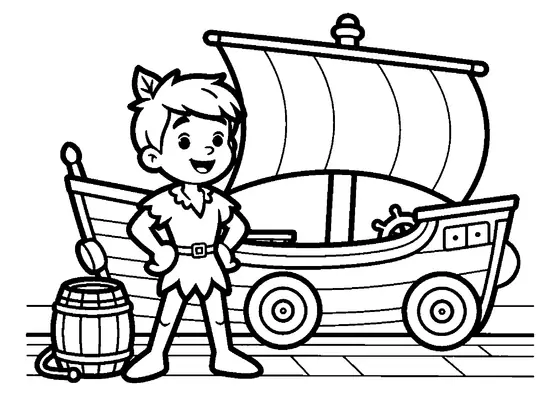
Peter Pan by the Ship’s Compass
A classic fable hero stands on the wooden deck of a sailing vessel right beside a large nautical compass.

A4 format (landscape), black outlines on a white background · for home and classroom use
All coloring pages: Fairy Tale Coloring Pages
Similar coloring pages: Fairy Tale Coloring Pages




What else can you print? Free, no account needed
Custom Name Coloring Pages
Enter your child's name to generate a custom coloring page featuring large outline letters to color and decorate.
Open generator →Connect the Dots Generator
Eight connect-the-dots pictures across three difficulty levels. Features faint outline guides for younger children and dots only for older kids.
Open generator →Printables
Worksheets, tracing lines, mazes and dot-to-dots in A4.
Browse printables →
Nautical Navigation and Deck Life
Traditional sailing vessels rely on precise instruments placed prominently on the upper deck to guide the ship across open waters. A navigational compass mounted near the steering area allows crew members to monitor directions continuously while managing sails and rigging. The wooden deck planks of old ocean ships were treated with pitch and oils to withstand harsh saltwater conditions.
Traditional Ship Compasses and Marine Travel
Maritime compasses were typically housed in protective wooden or brass stands called binnacles to keep magnetic needles stable during rough sea motion. Sailors used cardinal direction markings to track headings accurately across open oceans without visible landmarks. Brass was the preferred metal for navigational housing because it resists saltwater corrosion and does not interfere with magnetic fields.
Authentic Colors of Nautical Equipment
- Peter Pan outfit: forest green tunic with matching soft cap and dark brown belt
- Ship deck planks: weathered teak brown, warm amber, or golden tan
- Brass compass housing: metallic yellow-gold, polished bronze, or tarnished brown
- Compass rose dial: off-white paper or aged parchment with black lettering