
Alice in the Hall of Many Doors
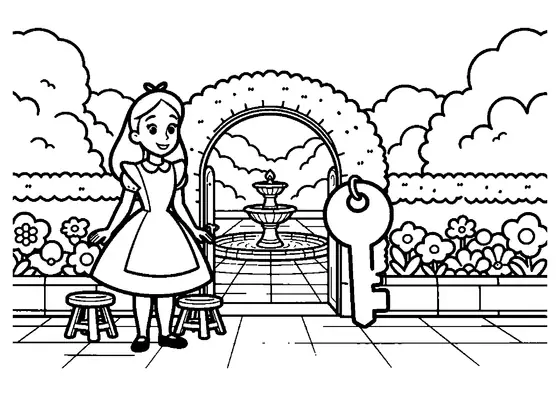
An enchanted interior filled with arched doorways surrounds a young traveler carrying an oversized key.

A4 format (portrait), black outlines on a white background · for home and classroom use
All coloring pages: Fairy Tale Coloring Pages
Similar coloring pages: Fairy Tale Coloring Pages




What else can you print? Free, no account needed
Custom Name Coloring Pages
Enter your child's name to generate a custom coloring page featuring large outline letters to color and decorate.
Open generator →Connect the Dots Generator
Eight connect-the-dots pictures across three difficulty levels. Features faint outline guides for younger children and dots only for older kids.
Open generator →Printables
Worksheets, tracing lines, mazes and dot-to-dots in A4.
Browse printables →
The Grand Hall of Arched Doors
Alice stands inside a grand magical hall containing numerous arched doors. She holds a large key while exploring the vast interior space. The architecture of the room features towering doorways that lead toward mystery.
Historic Locksmithing and Arched Architecture
Arched doorways were widely used in historic European architecture because the curved top distributes weight efficiently to support heavy stone walls. Ancient keys were often made of solid iron or brass, crafted in elaborate shapes to match complex mechanical locks. Grand entry halls in castles and mansions were designed to create impressive acoustic echoes.
Colors of Classic Interior Architecture
- Alice's hair: golden yellow, light auburn, or dark brown
- Large key: polished brass gold, antique bronze, or dark iron
- Arched doors: mahogany brown, dark walnut, or painted navy blue
- Door handles and fittings: metallic gold, copper, or silver
- Hall walls: cream stone, warm beige, or soft gray plaster