
Fairy Potter Making a Clay Pitcher
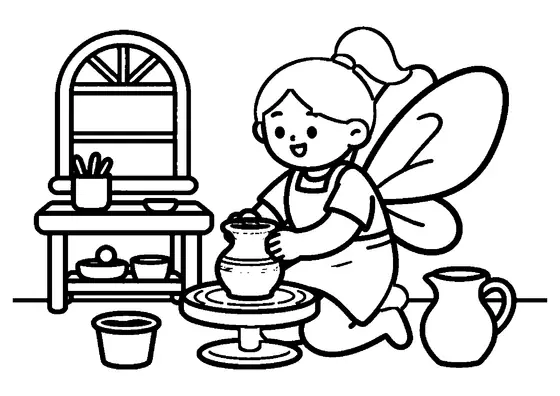
A smiling fairy potter shapes a clay pitcher on a pottery wheel inside a woodland workshop.

A4 format (landscape), black outlines on a white background · for home and classroom use
All coloring pages: Fairy Coloring Pages
Similar coloring pages: Fairy Coloring Pages


What else can you print? Free, no account needed
Custom Name Coloring Pages
Enter your child's name to generate a custom coloring page featuring large outline letters to color and decorate.
Open generator →Connect the Dots Generator
Eight connect-the-dots pictures across three difficulty levels. Features faint outline guides for younger children and dots only for older kids.
Open generator →Printables
Worksheets, tracing lines, mazes and dot-to-dots in A4.
Browse printables →
A fairy potter forming a pitcher
The fairy works at a pottery wheel, using the spinning surface to shape clay into a pitcher. Her woodland workshop provides a storybook setting for a real craft that depends on patient, balanced hand movements. The vessel's body, neck, rim, and handle each have a practical purpose.
Interesting facts about pottery wheels
Clay becomes workable when its fine mineral particles contain the right amount of water. On a pottery wheel, the clay must first be centered so that the vessel can rise evenly as it spins. After shaping and drying, real pottery is usually fired in a kiln, where heat makes it hard and durable.
Real colors of clay and pottery
- Wet clay: earthy red, terracotta, buff, brown, or gray
- Finished pitcher: natural clay tones or colors created by ceramic glaze
- Pottery wheel: wood brown, stone gray, or muted metal gray
- Fairy wings: translucent ivory, pale green, or light blue
- Woodland workshop: bark brown with leafy shades of green