
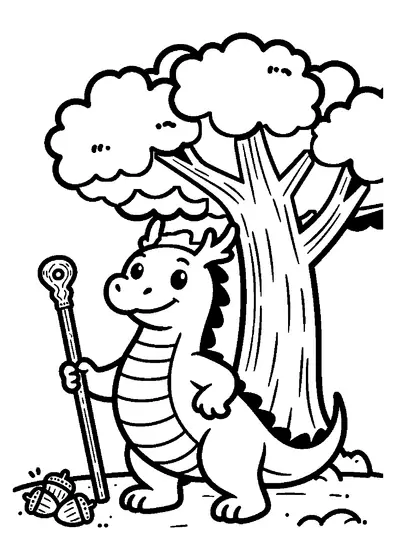
Dragon at a Forest Temple
A peaceful fairytale dragon rests quietly near ancient stone columns hidden deep within an overgrown woodland sanctuary.

A4 format (landscape), black outlines on a white background · for home and classroom use
All coloring pages: Dragon Coloring Pages
Similar coloring pages: Dragon Coloring Pages



What else can you print? Free, no account needed
Custom Name Coloring Pages
Enter your child's name to generate a custom coloring page featuring large outline letters to color and decorate.
Open generator →Connect the Dots Generator
Eight connect-the-dots pictures across three difficulty levels. Features faint outline guides for younger children and dots only for older kids.
Open generator →Printables
Worksheets, tracing lines, mazes and dot-to-dots in A4.
Browse printables →
Fairytale Dragon Resting in Ancient Temple Ruins
A gentle fairytale dragon takes shelter among the remains of an old forest temple. Thick tree roots wrap around weathered stone slabs and large carved columns that once supported the historic structure. A solitary stone pedestal stands nearby among the ancient ruins, surrounded by dense woodland foliage.
Ancient Forest Ruins and Tree Roots
Over hundreds of years, tree roots can grow through thick stone masonry, breaking solid blocks apart through a natural process called root wedging. Ancient stone structures in dense forests are often swallowed by vegetation when left uninhabited. Pedestals were traditionally built in historical temples to elevate statues, artifacts, or ceremonial offerings off the floor.
Real Colors of Ancient Forest Temples
- Temple stone columns and slabs: Weathered light gray, beige, and mossy green
- Tree roots and bark: Deep brown, dark tan, and chestnut
- Forest foliage: Olive green, dark forest green, and yellow-green leaves
- Dragon scales in fairytales: Soft turquoise, seafoam green, or warm amber