
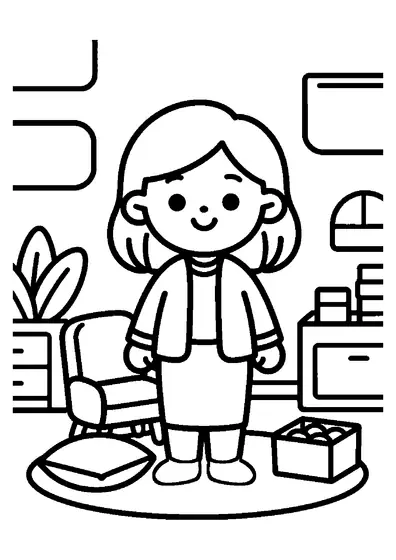
Speech Therapist with Mouth Model
A speech therapist uses specialized visual aids to support articulation practice during therapy sessions.

A4 format (portrait), black outlines on a white background · for home and classroom use
All coloring pages: Jobs and Professions Coloring Pages
Similar coloring pages: Jobs and Professions Coloring Pages




What else can you print? Free, no account needed
Custom Name Coloring Pages
Enter your child's name to generate a custom coloring page featuring large outline letters to color and decorate.
Open generator →Connect the Dots Generator
Eight connect-the-dots pictures across three difficulty levels. Features faint outline guides for younger children and dots only for older kids.
Open generator →Printables
Worksheets, tracing lines, mazes and dot-to-dots in A4.
Browse printables →
Speech and Language Therapy Exercises
This scene depicts a speech therapist using helpful tools during quiet speech practice sessions. A large anatomical mouth model stands in the room beside a soft chair and a box of picture cards.
Methods Used in Speech Pathologist Sessions
Speech-language pathologists assist individuals of all ages in improving articulation, voice clarity, fluency, and language comprehension. Visual models of teeth, tongue, and palate demonstrate correct oral placement for tricky consonant sounds like R, S, or TH. Flashcards featuring images help build vocabulary and reinforce correct pronunciation patterns through structured repetition.
Colors of Speech Therapy Equipment and Visual Aids
- Anatomical mouth model: Pink gums, white teeth, and reddish-pink tongue
- Session soft chair: Slate gray, sky blue, or muted teal fabric
- Box of picture cards: Bright yellow, royal blue, or durable clear plastic
- Printed picture cards: Colorful illustrations with white card borders