
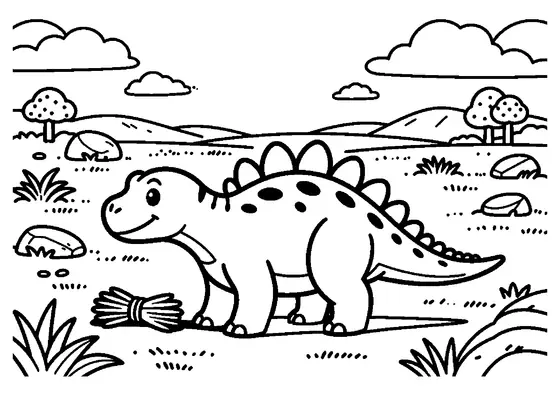
Struthiosaurus Next to a Large Basket
A small armored herbivore remains beside a woven container packed with leaves in a stony glade.

A4 format (portrait), black outlines on a white background · for home and classroom use
All coloring pages: Herbivorous Dinosaur Coloring Pages
Similar coloring pages: Herbivorous Dinosaur Coloring Pages



What else can you print? Free, no account needed
Custom Name Coloring Pages
Enter your child's name to generate a custom coloring page featuring large outline letters to color and decorate.
Open generator →Connect the Dots Generator
Eight connect-the-dots pictures across three difficulty levels. Features faint outline guides for younger children and dots only for older kids.
Open generator →Printables
Worksheets, tracing lines, mazes and dot-to-dots in A4.
Browse printables →
Struthiosaurus in a Rocky Glade
A Struthiosaurus is depicted in a rocky limestone clearing beside a large basket brimming with gathered leaves. The surrounding terrain highlights natural stone formations.
Facts About Struthiosaurus and Limestone Habitats
Struthiosaurus is one of the smallest known ankylosaurs, measuring around two meters in length. It lived on European islands during the Late Cretaceous period, where dwarfism was common among land animals due to limited island resources. Limestone clearings form when soluble rock dissolves, creating rugged glades where specialized vegetation thrives.
Colors Found in Nature
- Struthiosaurus back armor: sandy brown, muted green, or gray
- Woven basket: warm straw yellow, golden tan, or light brown
- Fresh foliage in basket: bright emerald green, lime green, or sage
- Limestone rock terrain: light gray, pale cream, or chalky off-white