
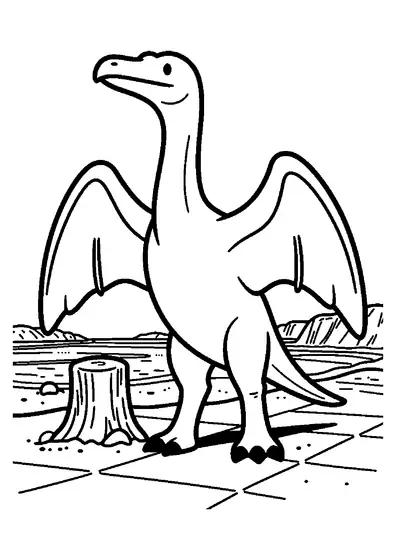
Dsungaripterus in a Clay Ravine
A robust Dsungaripterus rests inside a clay ravine bordered by smooth canyon walls, a rock slab, and a large shell.

A4 format (portrait), black outlines on a white background · for home and classroom use
All coloring pages: Flying and Sea Reptile Coloring Pages
Similar coloring pages: Flying and Sea Reptile Coloring Pages


What else can you print? Free, no account needed
Custom Name Coloring Pages
Enter your child's name to generate a custom coloring page featuring large outline letters to color and decorate.
Open generator →Connect the Dots Generator
Eight connect-the-dots pictures across three difficulty levels. Features faint outline guides for younger children and dots only for older kids.
Open generator →Printables
Worksheets, tracing lines, mazes and dot-to-dots in A4.
Browse printables →
A Shell-Crushing Pterosaur in Clay Canyons
Dsungaripterus was a sturdy flying reptile known for its thick bones and powerful, upward-curving jaws. Inland clay ravines and dry wash channels provided natural shelter from high winds and land-based predators. In this dry environment, rounded clay walls framing a slab of rock and an oversized shell reflect the coastal-inland habitats where Dsungaripterus scavenged and hunted.
How Clay Ravines Are Sculpted by Water
Clay ravines are carved over long periods by intermittent rainwater runoff cutting through soft clay soil. Because clay particles bind tightly together, flowing water slowly smooths and rounds the steep canyon walls rather than creating sharp, jagged edges. These sheltered gullies often preserve ancient fossils and buried shells remarkably well.
Natural Tones of Clay Landscapes and Dsungaripterus
- Dsungaripterus body: Earthy brown or olive gray
- Jaws and beak tip: Pale ivory or dull yellow
- Clay ravine walls: Terracotta red, ochre, or yellowish brown
- Rock slab: Dark gray or weathered slate
- Large shell: Off-white, beige, or pale tan