
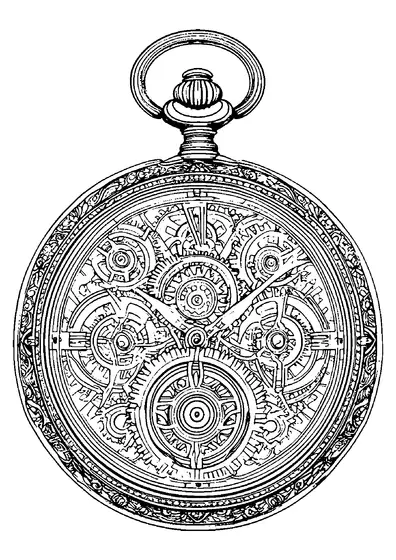
Retro Pocket Watch With Exposed Mechanism
An open retro pocket watch reveals interlocking internal gears without numbers or lettering.

Print Download PNG
A4 format (portrait), black outlines on a white background · for home and classroom use
Advertisement
All coloring pages: Adult Coloring Pages
More from this category
Similar coloring pages: Adult Coloring Pages





Mechanical Pocket Watch Mechanism
The depiction highlights a mechanical pocket watch showcasing visible internal gears and components. Mechanical timepieces operate without electronic batteries, using a network of interconnected wheels to measure time.
How Mechanical Pocket Watches Function
Mechanical watches rely on a coiled mainspring that releases energy steadily through a gear train. Watchmakers used small rubies or synthetic sapphires inside the movement to reduce friction between moving metal parts. Open-face designs allow the intricate internal movement to remain visible.
Authentic Metals in Pocket Watches
- External watch case: Polished yellow gold, aged brass, or silver
- Internal gears and wheels: Bright brass, copper, or steel
- Watch jewels: Translucent ruby red or deep pink
- Watch face plate: Off-white enamel or brushed metallic gray
Questions and answers
Questions and Answers
Why do mechanical pocket watches contain so many small gears?
Each gear rotates at a precise speed ratio to transfer power from the mainspring to the hands. This careful engineering ensures accurate measurement of seconds, minutes, and hours.
What metal is typically used to build internal watch mechanisms?
Watchmakers commonly use brass for gears because it resists corrosion and is easy to machine accurately. Steel is often chosen for springs and axles requiring higher strength.