
Intricate Pattern of Elongated Leaves
A dense arrangement of elongated leaves repeats symmetrically across the page, with branching veins visible inside each blade.

A4 format (portrait), black outlines on a white background · for home and classroom use
All coloring pages: Pattern and Ornament Coloring Pages
Similar coloring pages: Pattern and Ornament Coloring Pages


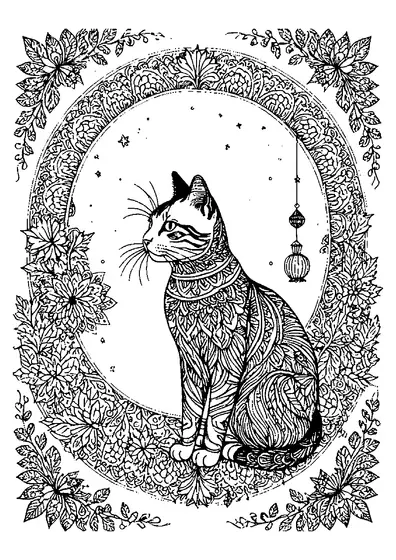


The Symmetrical Pattern of Elongated Leaves
Long leaves overlap and radiate through a tightly packed botanical composition. Their pointed shapes repeat in mirrored groups, while the veins divide each leaf into smaller sections. Leaves fill the entire background, creating a continuous plant-inspired pattern from edge to edge.
How Leaf Veins Support a Plant
The veins in a real leaf carry water and dissolved minerals into its tissues while transporting sugars produced during photosynthesis. They also help support the leaf blade, much as a framework helps a flat surface keep its shape. Vein patterns differ among plant groups and can help botanists identify species.
Natural Colors Found in Elongated Leaves
- Young leaf blades: often light, bright, or yellow-green
- Mature leaf blades: commonly medium to deep green
- Main veins: pale green, cream, yellowish, or darker green
- Smaller branching veins: usually close to the blade color, with a subtle lighter or darker tone
- Aging leaves: may turn yellow, orange, red, brown, or a mixture of these shades