
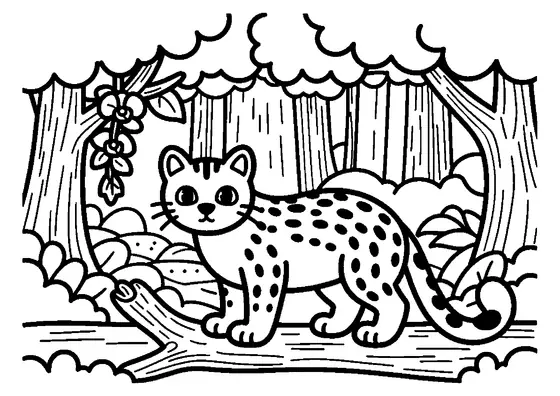
Pangolin on a Tropical Forest Trail
A scaly pangolin navigates a narrow wilderness path through the dense vegetation of a tropical rainforest.

A4 format (portrait), black outlines on a white background · for home and classroom use
All coloring pages: Wild Animal Coloring Pages
Similar coloring pages: Wild Animal Coloring Pages


What else can you print? Free, no account needed
Custom Name Coloring Pages
Enter your child's name to generate a custom coloring page featuring large outline letters to color and decorate.
Open generator →Connect the Dots Generator
Eight connect-the-dots pictures across three difficulty levels. Features faint outline guides for younger children and dots only for older kids.
Open generator →Printables
Worksheets, tracing lines, mazes and dot-to-dots in A4.
Browse printables →
Scaly Pangolin Exploring a Rainforest Trail
A scaly pangolin walks along a forest trail winding through a dense tropical rainforest. This solitary nocturnal mammal moves across the dirt pathway while surrounded by lush jungle growth.
Unique Adaptations of the Pangolin
Pangolins are the only mammals in the world covered entirely in protective keratin scales, which are made of the same material as human fingernails. When threatened by predators like leopards, a pangolin rolls into a tight, impenetrable ball to shield its soft underbelly. Their extremely long, sticky tongues can extend up to sixteen inches to scoop thousands of ants and termites directly from subterranean nests.
Natural Colors of the Pangolin and Rainforest
- Pangolin keratin scales: Overlapping protective scales range from yellowish-brown and dark olive to earthy gray-brown.
- Pangolin skin and underbelly: Unarmored skin on the face and belly features soft pinkish-tan or pale gray tones.
- Rainforest trail soil: Tropical forest dirt paths vary from rich reddish clay to damp dark brown earth.
- Rainforest foliage: Tropical rainforest leaves exhibit deep emerald green, bright lime, and shaded olive tones.