
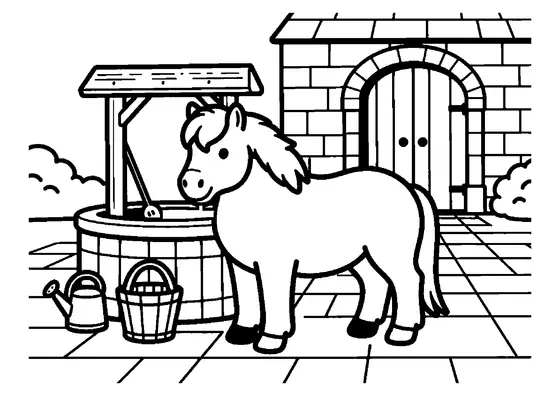
Shetland Pony in an Old Castle Courtyard
Historical fortresses featuring stone courtyards provide a majestic setting for sturdy Shetland ponies wearing ornamental blankets.

A4 format (portrait), black outlines on a white background · for home and classroom use
All coloring pages: Pony Coloring Pages
Similar coloring pages: Pony Coloring Pages



What else can you print? Free, no account needed
Custom Name Coloring Pages
Enter your child's name to generate a custom coloring page featuring large outline letters to color and decorate.
Open generator →Connect the Dots Generator
Eight connect-the-dots pictures across three difficulty levels. Features faint outline guides for younger children and dots only for older kids.
Open generator →Printables
Worksheets, tracing lines, mazes and dot-to-dots in A4.
Browse printables →
Shetland Ponies in Historic Courtyards
A Shetland pony adorned with a decorative saddlecloth stands within the stone courtyard of an ancient castle. Historic stone masonry and aged architectural features surround the small animal.
The History of Shetland Ponies and Historic Estates
Shetland ponies originated in the harsh climate of the Shetland Isles, where small size and dense bones made them remarkably strong for their height. Nobles across Europe historically kept these calm animals on grand estates for light transport and ceremonial purposes. Old castles relied on paved cobblestone courtyards to withstand heavy horse hooves and iron wagon wheels.
Traditional Colors of Castle Architecture and Saddlery
- Castle stone walls: light gray, charcoal, beige, or mossy brown
- Decorative saddlecloth: crimson red, royal blue, gold trim, or emerald green
- Shetland pony coat: dark brown, solid black, chestnut, or piebald
- Courtyard cobblestones: slate gray, earth brown, or weathered granite
- Pony eyes: dark brown, hazel, or deep black