
Fjord Pony by a Woodland Cabin
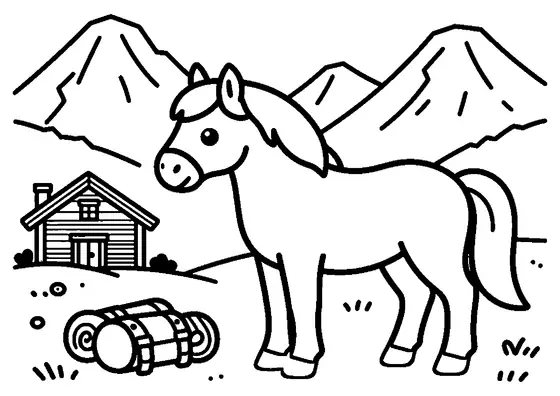
A distinctive Fjord pony rests near a rustic wooden cabin set against scenic mountain slopes.

A4 format (portrait), black outlines on a white background · for home and classroom use
All coloring pages: Horse Coloring Pages
Similar coloring pages: Horse Coloring Pages



What else can you print? Free, no account needed
Custom Name Coloring Pages
Enter your child's name to generate a custom coloring page featuring large outline letters to color and decorate.
Open generator →Connect the Dots Generator
Eight connect-the-dots pictures across three difficulty levels. Features faint outline guides for younger children and dots only for older kids.
Open generator →Printables
Worksheets, tracing lines, mazes and dot-to-dots in A4.
Browse printables →
Norwegian Fjord Pony in Mountain Country
A Norwegian Fjord pony stands near a wooden woodland cabin nestled within a high mountain landscape. The quiet mountain setting highlights the sturdy build of this traditional breed surrounded by steep terrain and timber structures.
Unique Features of the Fjord Horse Breed
Fjord horses are one of the world's oldest wild horse breeds, native to the mountainous regions of Norway. They possess a characteristic dun coat accompanied by a dark stripe running down the spine and through the center of the mane. Traditionally, owners clip the mane into a crescent shape so the dark inner hair stands erect framed by lighter outer hair.
Real Colors of the Fjord Pony and Mountain Setting
- Fjord pony coat: classic dun, light yellow-brown, or pale cream
- Spine stripe and mane center: dark brown or charcoal black
- Pony mane edges and tail sides: silvery white or light cream
- Woodland cabin walls: weathered timber brown, dark pine, or gray wood
- Mountain peaks: slate gray rock, granite, or white snow cover