
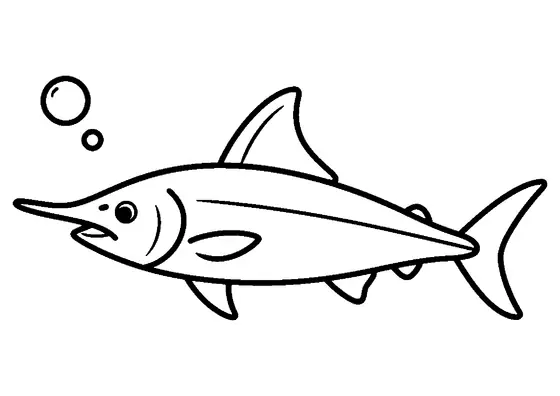
Tuna Swimming Past Two Bubbles
A large torpedo-shaped tuna glides through open water beside a pair of rising air bubbles.

A4 format (landscape), black outlines on a white background · for home and classroom use
All coloring pages: Fish and Ocean Life Coloring Pages
Similar coloring pages: Fish and Ocean Life Coloring Pages



What else can you print? Free, no account needed
Custom Name Coloring Pages
Enter your child's name to generate a custom coloring page featuring large outline letters to color and decorate.
Open generator →Connect the Dots Generator
Eight connect-the-dots pictures across three difficulty levels. Features faint outline guides for younger children and dots only for older kids.
Open generator →Printables
Worksheets, tracing lines, mazes and dot-to-dots in A4.
Browse printables →
Streamlined Tuna in the Open Ocean
This depiction features an ocean tuna traveling through open water. The sleek predator shows its streamlined body shape built for high-speed movement across deep marine environments. Two tiny air bubbles float near the top corner above the fish, emphasizing its movement through the liquid surroundings.
Hydrodynamic Ocean Hunters
Tunas are among the fastest swimmers in the sea, capable of reaching remarkable speeds while migrating thousands of miles across whole ocean basins. Unlike most cold-blooded fish, tunas can elevate their body temperature above the surrounding water, which allows their muscles to function efficiently in cold depths. Their specialized tail fins generate powerful forward propulsion while minimizing drag.
Natural Colors of the Ocean Tuna
- Tuna back: dark metallic blue or deep navy
- Tuna sides and belly: silvery white with iridescent shimmer
- Tuna fins: dark gray or yellowish tint
- Air bubbles: light translucent blue with white highlights