
Saint Bernard at a Forest Narrow-Gauge Railway Station
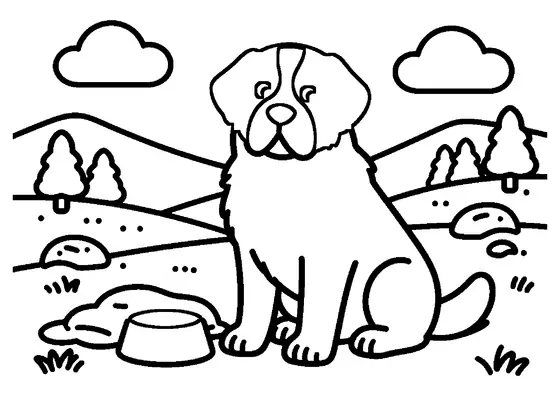
A Saint Bernard sits near a wooden platform at a quiet narrow-gauge railway station surrounded by trees.

A4 format (landscape), black outlines on a white background · for home and classroom use
All coloring pages: Dog Coloring Pages
Similar coloring pages: Dog Coloring Pages



What else can you print? Free, no account needed
Custom Name Coloring Pages
Enter your child's name to generate a custom coloring page featuring large outline letters to color and decorate.
Open generator →Connect the Dots Generator
Eight connect-the-dots pictures across three difficulty levels. Features faint outline guides for younger children and dots only for older kids.
Open generator →Printables
Worksheets, tracing lines, mazes and dot-to-dots in A4.
Browse printables →
Saint Bernard Dog at a Woodland Train Station
A large Saint Bernard spends time at a small narrow-gauge railway stop hidden deep within a woodland setting. Next to a cozy station building and a passenger platform, the scene combines elements of historic rail transport with the tranquility of surrounding nature.
Alpine Rescue Dogs and Mountain Rail
Saint Bernards were originally bred by monks at the Great St. Bernard Hospice in the Swiss Alps to locate trapped travelers in heavy snow. Narrow-gauge railways were often built through dense forests and rugged mountainous terrain because their smaller tracks required less clearing and could handle sharper turns than standard railroads.
Real Colors of Saint Bernards and Forest Stations
- Saint Bernard fur: White base with reddish-brown or mahogany patches on the back and head
- Dog muzzle and eye rims: Black or dark brown skin markings around the face
- Station building exterior: Painted or natural weathered wood in brown, dark green, or gray
- Railway track ballast: Dark gray crushed stone surrounding wooden track ties
- Forest foliage: Deep green pine needles and rich brown tree bark