
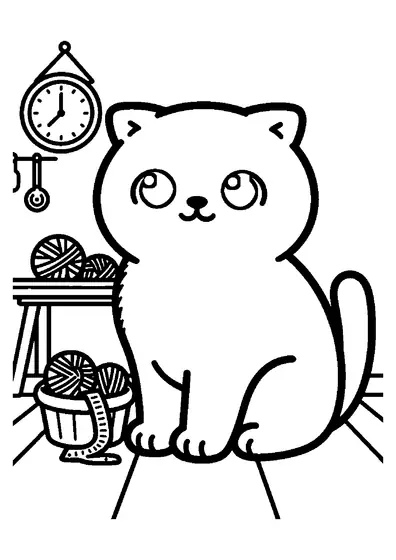
Scottish Fold Cat in a Yarn Shop
An adorable Scottish Fold cat settles comfortably beside a woven basket overflowing with colorful skeins of yarn.

A4 format (portrait), black outlines on a white background · for home and classroom use
All coloring pages: Cat Breed Coloring Pages
Similar coloring pages: Cat Breed Coloring Pages



What else can you print? Free, no account needed
Custom Name Coloring Pages
Enter your child's name to generate a custom coloring page featuring large outline letters to color and decorate.
Open generator →Connect the Dots Generator
Eight connect-the-dots pictures across three difficulty levels. Features faint outline guides for younger children and dots only for older kids.
Open generator →Printables
Worksheets, tracing lines, mazes and dot-to-dots in A4.
Browse printables →
Scottish Fold Cat with a Woven Yarn Basket
A gentle Scottish Fold cat lounges in a craft shop next to a basket filled with yarn materials. The distinctive folded ears of the cat complement the warm, domestic setting of a traditional sewing corner.
Facts About Scottish Folds and Textile Crafts
The unique folded ears of the Scottish Fold cat stem from a natural genetic mutation discovered in Scotland in the 1960s. These cats are famous for sitting in unusual positions, such as flat on their backs or sitting upright like an owl. Wool yarn used in craft shops is spun from animal fleece and wound into neat skeins or balls for knitting and crocheting.
Realistic Colors for Craft Scenes
- Scottish Fold fur: soft gray, silver tabby, white, or warm cream
- Cat eyes: large round eyes in amber, gold, or green
- Folded ear interiors: pale pink skin with fine white fur
- Woven yarn basket: golden natural straw, tan wicker, or dark brown cane
- Wool yarn balls: vibrant shades of crimson red, sky blue, sunny yellow, and violet