
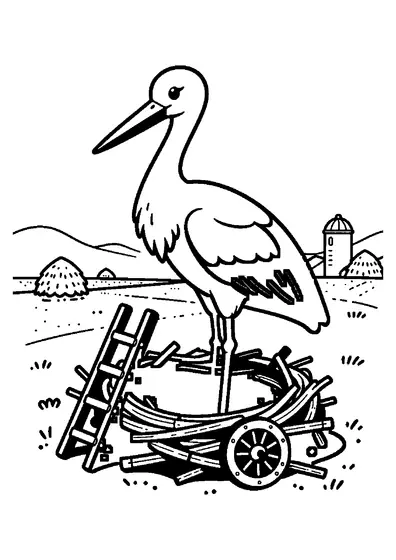
Stork Beside an Old Farm Wagon
A stately white stork rests near an old wooden farm wagon parked outside a traditional countryside barn.

A4 format (landscape), black outlines on a white background · for home and classroom use
All coloring pages: Bird Coloring Pages
Similar coloring pages: Bird Coloring Pages

What else can you print? Free, no account needed
Custom Name Coloring Pages
Enter your child's name to generate a custom coloring page featuring large outline letters to color and decorate.
Open generator →Connect the Dots Generator
Eight connect-the-dots pictures across three difficulty levels. Features faint outline guides for younger children and dots only for older kids.
Open generator →Printables
Worksheets, tracing lines, mazes and dot-to-dots in A4.
Browse printables →
A White Stork Standing Beside a Farm Wagon
This rural scene features a white stork standing beside a rustic wooden farm wagon. Situated on a traditional country farm, the backdrop includes a barn structure that reflects rural agricultural life.
Remarkable Facts About Storks on Farms
White storks are large wading birds that often nest on rooftop chimneys, wooden cart wheels placed on poles, and farm barn roofs across rural Europe. Farmers welcome storks near their yards because the birds consume grasshoppers, rodents, and agricultural pests in nearby pastures. Storks communicate by rapidly clattering their long bills together, producing a rhythmic drum-like sound that echoes across farmsteads.
Natural Colors of the Stork and Farmyard Elements
- Stork body feathers: Pure white plumage covering the head, neck, and main body
- Stork wing tips: Glossy jet-black flight feathers along the rear wing edges
- Stork beak and legs: Deep crimson red bill and long red legs
- Rustic farm wagon: Aged gray wood planks with rusty iron rimmed wheels
- Barn exterior: Red painted timber siding or natural brown barn wood