
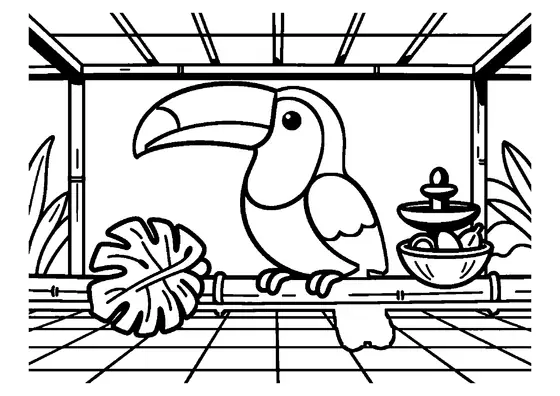
Royal Macaw on a Perch in a Conservatory
A colorful long-tailed macaw sits on a wooden perch among lush banana plants inside a glass conservatory.

A4 format (portrait), black outlines on a white background · for home and classroom use
All coloring pages: Bird Coloring Pages
Similar coloring pages: Bird Coloring Pages



What else can you print? Free, no account needed
Custom Name Coloring Pages
Enter your child's name to generate a custom coloring page featuring large outline letters to color and decorate.
Open generator →Connect the Dots Generator
Eight connect-the-dots pictures across three difficulty levels. Features faint outline guides for younger children and dots only for older kids.
Open generator →Printables
Worksheets, tracing lines, mazes and dot-to-dots in A4.
Browse printables →
Macaw in a Tropical Conservatory
A long-tailed macaw rests on a wooden perch surrounded by tropical banana plants inside a sunlit conservatory. Large glass panels line the background, enclosing a lush indoor botanical garden setting.
Fascinating Facts About Macaws
Macaws are known for having extremely strong beaks capable of cracking tough tropical nuts and seed shells with ease. They use their specialized toes, two facing forward and two facing backward, to grasp food like small hands. In the wild, macaws often form lifelong bonds with their mates and fly together in vibrant pairs.
Natural Colors of the Macaw and Conservatory
- Macaw feathers: brilliant combination of scarlet red, royal blue, bright yellow, and turquoise green
- Macaw facial skin: pale ivory white with fine black feather lines
- Banana plant leaves: deep emerald green and vibrant lime tones
- Wooden perch: warm mahogany brown or dry tree-bark gray
- Conservatory glass panels: clear sky reflection with muted iron framing gray