
Yellow-Eyed Penguin by the Wetlands
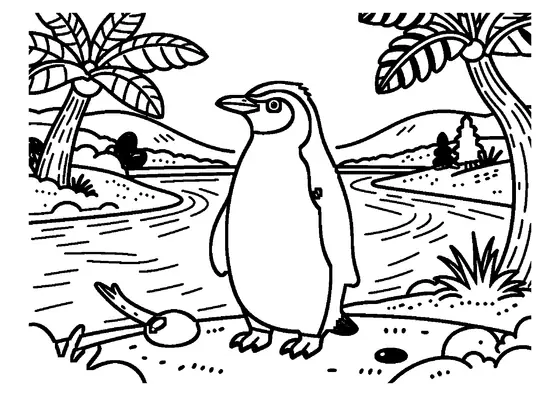
A yellow-eyed penguin walks near a dropped feather along a coastal wetland channel bordered by reeds and hills.

A4 format (portrait), black outlines on a white background · for home and classroom use
All coloring pages: Penguin Coloring Pages
Similar coloring pages: Penguin Coloring Pages



What else can you print? Free, no account needed
Custom Name Coloring Pages
Enter your child's name to generate a custom coloring page featuring large outline letters to color and decorate.
Open generator →Connect the Dots Generator
Eight connect-the-dots pictures across three difficulty levels. Features faint outline guides for younger children and dots only for older kids.
Open generator →Printables
Worksheets, tracing lines, mazes and dot-to-dots in A4.
Browse printables →
Yellow-Eyed Penguins in Coastal Wetland Habitats
The scene displays a yellow-eyed penguin walking along the margin of a coastal wetland. A single feather lies on the ground beside the pathway. Tall reeds line a nearby water channel, while rolling green hills form the surrounding environment where this rare bird resides.
Solitary Forest and Coastal Dwellers
Native to New Zealand, the yellow-eyed penguin is unique because it nests in secluded coastal forests and wetlands rather than forming crowded colonies. They communicate using distinct high-pitched calls that carry through dense coastal foliage. Their yellow eye iris and matching yellow head band develop fully as the birds mature into adulthood.
Natural Colors of the Yellow-Eyed Penguin
- Eyes and head band: pale yellow
- Crown and cheeks: yellow with brown streaks
- Back and flippers: slate gray
- Chest and abdomen: solid white
- Reeds and marsh grass: olive green