
Pelican on a Stone Harbor Wall
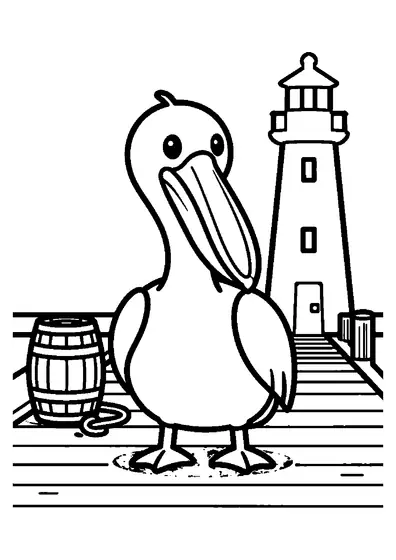
A large pelican stands on a stone harbor wall beside a crate of fish and a coiled rope in a fishing port.

A4 format (landscape), black outlines on a white background · for home and classroom use
All coloring pages: Bird Coloring Pages
Similar coloring pages: Bird Coloring Pages


What else can you print? Free, no account needed
Custom Name Coloring Pages
Enter your child's name to generate a custom coloring page featuring large outline letters to color and decorate.
Open generator →Connect the Dots Generator
Eight connect-the-dots pictures across three difficulty levels. Features faint outline guides for younger children and dots only for older kids.
Open generator →Printables
Worksheets, tracing lines, mazes and dot-to-dots in A4.
Browse printables →
A Pelican Resting by a Harbor Dock
A large pelican perches on top of a stone harbor wall in a fishing port. Beside the bird rests a crate packed with fresh fish and a thick coil of maritime rope.
Coastal Bird Behavior and Fishing Ports
Brown and white pelicans frequent coastal fishing harbors, where they gather near docks and fish packing stations. Pelicans possess a distinctive throat pouch called a gular sac, which expands to scoop up fish and water during feeding dives. Fishing harbors provide quiet perches where these large sea birds rest and dry their feathers between foraging flights.
Natural Colors of Harbor Birds and Equipment
- Pelican feathers: grayish-white body plumage with dark brown wing tips
- Pelican bill and pouch: pale yellow beak with a pinkish or yellowish gular pouch
- Stone harbor wall: weathered gray granite and muted tan mortar
- Crate of fish: pale wooden slats holding silver and blue-scaled fish
- Maritime rope: natural tan hemp or light brown jute fibers