
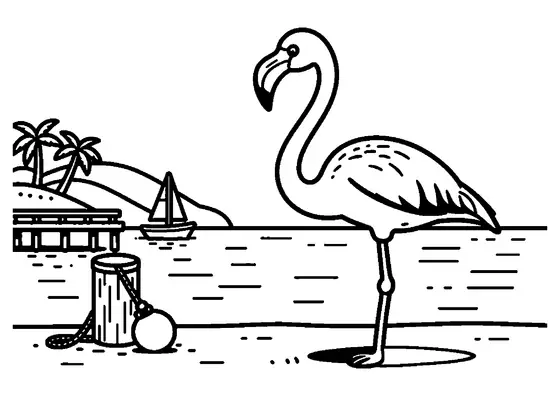
Greater Flamingo Beside Driftwood on a Coastal Dune
A coastal landscape highlights a greater flamingo standing near weathered driftwood on a sandy dune near the sea.

A4 format (landscape), black outlines on a white background · for home and classroom use
All coloring pages: Parrot and Flamingo Coloring Pages
Similar coloring pages: Parrot and Flamingo Coloring Pages


What else can you print? Free, no account needed
Custom Name Coloring Pages
Enter your child's name to generate a custom coloring page featuring large outline letters to color and decorate.
Open generator →Connect the Dots Generator
Eight connect-the-dots pictures across three difficulty levels. Features faint outline guides for younger children and dots only for older kids.
Open generator →Printables
Worksheets, tracing lines, mazes and dot-to-dots in A4.
Browse printables →
Greater Flamingo on a Coastal Dune
On a breezy seaside shore, a greater flamingo rests on a sandy dune beside weathered driftwood. A tall lighthouse stands in the background beyond the coastal beach landscape.
Interesting Facts About Coastal Flamingos
Greater flamingos often gather in shallow coastal waters and salty lagoons where they filter food from mud using specialized downturned beaks. They frequently stand on one leg to conserve body heat while resting on open beaches and tidal flats. Driftwood washed up on coastal dunes provides shelter and perches for various coastal shorebirds.
Natural Colors of the Coastal Flamingo Scene
- Flamingo feathers: Soft pink with deep salmon undertones and black wing tips
- Flamingo bill: Pale pink with a distinct black tip
- Coastal dune sand: Light beige, pale yellow, and cream tones
- Weathered driftwood: Pale gray, silver, and faded brownish tones
- Coastal lighthouse: Classic white and bold red striped pattern with a dark lantern room