
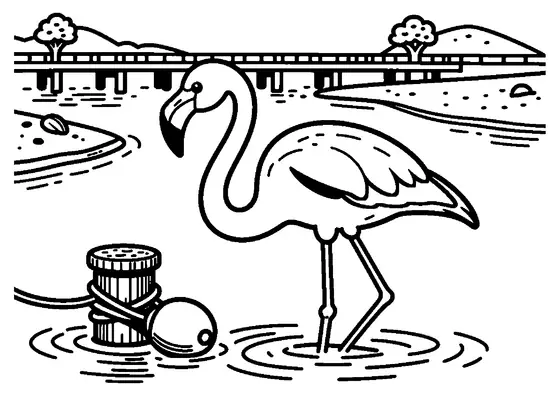
Chilean Flamingo by a Reed-Lined River Dock
A Chilean flamingo wades through water beside a wooden dock and river reeds.

A4 format (landscape), black outlines on a white background · for home and classroom use
All coloring pages: Parrot and Flamingo Coloring Pages
Similar coloring pages: Parrot and Flamingo Coloring Pages




What else can you print? Free, no account needed
Custom Name Coloring Pages
Enter your child's name to generate a custom coloring page featuring large outline letters to color and decorate.
Open generator →Connect the Dots Generator
Eight connect-the-dots pictures across three difficulty levels. Features faint outline guides for younger children and dots only for older kids.
Open generator →Printables
Worksheets, tracing lines, mazes and dot-to-dots in A4.
Browse printables →
Chilean Flamingo in a River Environment
A Chilean flamingo wades through shallow river water surrounded by tall reeds. A wooden dock stands along the water edge near the wading bird.
Wetland Life of the Chilean Flamingo
Chilean flamingos thrive in brackish lakes and freshwater river estuaries throughout South America. They use specialized comb-like structures in their curved beaks to filter algae and small aquatic organisms while wading. The thick reed beds along riverbanks offer vital shelter and nesting areas for water birds.
Colors of the Chilean Flamingo and River Scene
- Chilean flamingo feathers: pale pink body with bright crimson patches on the wings
- Flamingo legs and joints: dark gray legs accented with pink knee joints and webbed feet
- Flamingo beak: soft pink near the face ending in a bold black tip
- River reeds: emerald green stalks with brownish seed heads
- Wooden dock: weathered timber gray or warm natural brown