
Budgie Beside a Clay Bowl of Seeds on the Deck
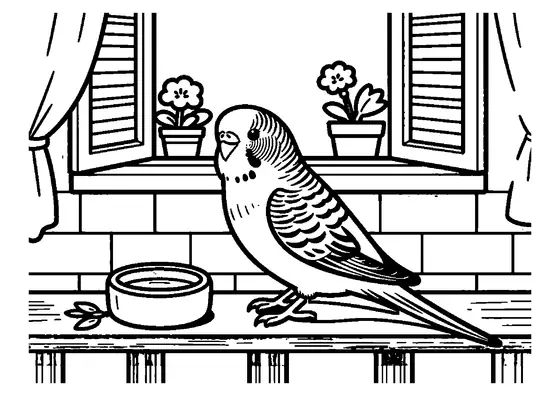
A small budgie perches on a slender bamboo rod right next to a terracotta clay bowl filled with seeds on a wooden deck.

A4 format (portrait), black outlines on a white background · for home and classroom use
All coloring pages: Parrot and Flamingo Coloring Pages
Similar coloring pages: Parrot and Flamingo Coloring Pages


What else can you print? Free, no account needed
Custom Name Coloring Pages
Enter your child's name to generate a custom coloring page featuring large outline letters to color and decorate.
Open generator →Connect the Dots Generator
Eight connect-the-dots pictures across three difficulty levels. Features faint outline guides for younger children and dots only for older kids.
Open generator →Printables
Worksheets, tracing lines, mazes and dot-to-dots in A4.
Browse printables →
A Budgie Beside a Clay Seed Bowl
A cheerful budgerigar perches on a bamboo rod right beside a heavy clay bowl filled with grains and seeds on an outdoor wooden deck. Budgies are small Australian parrots that naturally feed on ground seeds and grassy grains.
Fascinating Traits of Wild and Domestic Budgies
Wild budgerigars originate from the arid inland grasslands of Australia, where nomadic flocks travel great distances following seasonal rainfall. While wild budgies are almost exclusively green and yellow for camouflage in dry grasses, selective breeding has produced domestic pet varieties with bright blue, white, and violet feather patterns. Their light weight enables them to balance effortlessly on slender bamboo stems.
Natural Colors of the Budgie and Deck Setup
- Wild budgie body: lime green with a yellow face
- Wing feathers: black wave patterns over yellow backgrounds
- Clay bowl: terracotta orange or reddish brown
- Bamboo rod: pale green or yellowish golden tan
- Deck flooring: natural brown cedar wood