
Kookaburra on a Wooden Gazebo
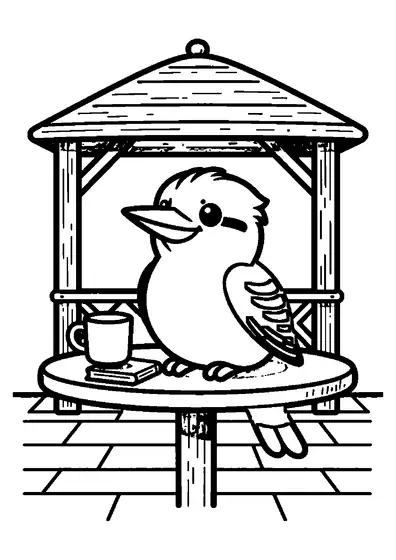
A wild kookaburra sits on a wooden gazebo post against a peaceful forest backdrop.

A4 format (portrait), black outlines on a white background · for home and classroom use
All coloring pages: Bird Coloring Pages
Similar coloring pages: Bird Coloring Pages


What else can you print? Free, no account needed
Custom Name Coloring Pages
Enter your child's name to generate a custom coloring page featuring large outline letters to color and decorate.
Open generator →Connect the Dots Generator
Eight connect-the-dots pictures across three difficulty levels. Features faint outline guides for younger children and dots only for older kids.
Open generator →Printables
Worksheets, tracing lines, mazes and dot-to-dots in A4.
Browse printables →
The Kookaburra on a Wooden Structure
Native to Australian woodlands, the laughing kookaburra is a large kingfisher species known for sitting patiently on garden structures and tree branches. Positioned atop a wooden gazebo post in the forest, it scans the surrounding ground for small prey.
Remarkable Kookaburra Behaviors
The famous laughing call of the kookaburra is actually a territorial warning used by family groups to establish boundary lines at dawn and dusk. Unlike most kingfishers, kookaburras rarely catch fish, preferring terrestrial prey like insects, lizards, and small snakes.
Authentic Colors of the Kookaburra
- Kookaburra head and chest: off-white to pale cream with a brown eye stripe
- Kookaburra wings: dark brown with mottled sky-blue feathers
- Kookaburra beak: dark blackish brown on top and tan below
- Wooden gazebo post: natural brown timber or weathered gray timber
- Kookaburra tail: reddish brown with dark bars and white tips