
Heron Standing on Rocks
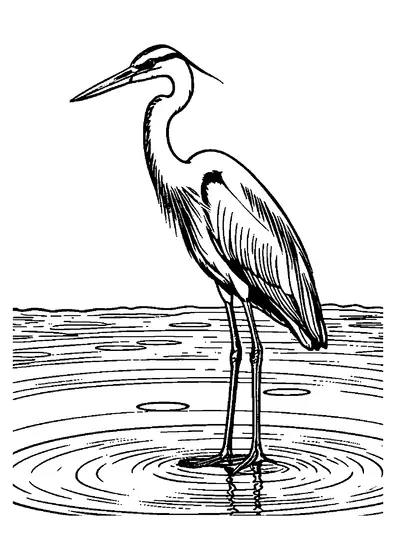
Perched above a row of smooth rocks, a tall heron displays its long curved neck, pointed beak, and slender legs.

A4 format (portrait), black outlines on a white background · for home and classroom use
All coloring pages: Bird Coloring Pages
Similar coloring pages: Bird Coloring Pages




What else can you print? Free, no account needed
Custom Name Coloring Pages
Enter your child's name to generate a custom coloring page featuring large outline letters to color and decorate.
Open generator →Connect the Dots Generator
Eight connect-the-dots pictures across three difficulty levels. Features faint outline guides for younger children and dots only for older kids.
Open generator →Printables
Worksheets, tracing lines, mazes and dot-to-dots in A4.
Browse printables →
Heron Standing on Rocks
A single heron stands on rounded rocks with its body held upright. Its narrow legs support a feathered body, while the extended beak and gently curved neck create the bird’s recognizable profile. The open background keeps attention on the heron and the stones beneath its feet.
Interesting facts about herons
Herons often wait quietly beside lakes, rivers, marshes, and coastal shallows before striking quickly at prey. Their specially shaped neck vertebrae allow the neck to fold into an S shape and then extend with remarkable speed. Rocks near water can provide firm places for resting, watching, or searching the shallows.
Colors of a Real Heron
- Feathers: white, blue-gray, slate gray, brown, or black, depending on the species
- Long beak: commonly yellow, orange, gray, or dark brown
- Eyes: often yellow, amber, or reddish brown
- Slender legs: yellow, brown, gray, greenish, or nearly black
- Smooth rocks: natural shades of gray, tan, brown, rust, or charcoal